

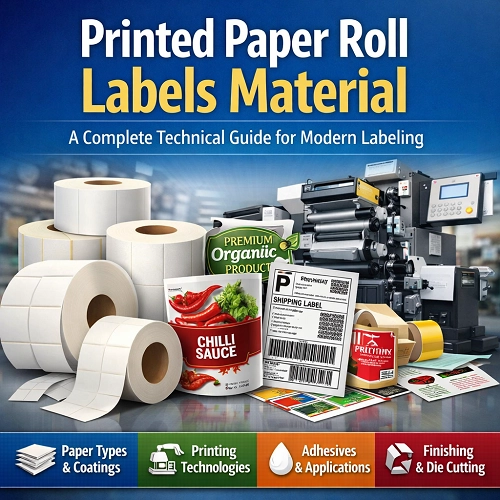
Printed Paper Roll Labels Material: A Complete Technical Guide for Modern Labeling
In today's fast-moving supply chains, printed paper roll labels material is a cornerstone of product identification, compliance, logistics, and brand presentation. From the cold aisles of a food warehouse to the shelves of a premium cosmetics retailer, the right label material determines whether a product communicates accurately and professionally — or fails in the field.
This guide explores the technical landscape of paper roll label materials, covering base paper types, adhesive systems, liner configurations, print technologies, storage best practices, and real-world industry applications. References draw from the Prime Paper Label Material product line offered by TGX Group (Targanix), a Zhejiang-based manufacturer specializing in self-adhesive materials, release papers, and specialty papers.
1. What Is Printed Paper Roll Labels Material?
Printed paper roll labels material refers to a multi-layer self-adhesive substrate supplied in roll form, ready for printing and die-cutting into finished labels. Each roll consists of three primary layers:
Together, these layers form a precisely engineered composite that must perform consistently across printing, die-cutting, application, and end-use environments. Leading manufacturers such as TGX Group invest heavily in surface coating, adhesive formulation, and liner calibration to ensure every roll meets exacting standards.
2. Base Paper Types: Choosing the Right Face Stock
The face stock determines print quality, surface aesthetics, and durability. Targanix's Prime Paper Label Material range covers the most widely used base paper grades across global markets.
| Paper Type | Key Characteristics | Typical Weight | Best For |
|---|---|---|---|
| High Gloss Paper | Bright, reflective surface; vivid color reproduction; excellent ink hold-out | 80–100 g/m² | Premium food, cosmetics, retail packaging |
| Semi Gloss Paper | Balanced sheen; reduced glare; good scannability for barcodes | 80–90 g/m² | Logistics, pharmaceutical, general retail |
| Lightweight Semi Gloss | Cost-efficient; lower caliper; smooth print surface | 60–70 g/m² | High-volume shipping and e-commerce labels |
| Woodfree Paper | Matte, uncoated feel; natural appearance; good writability | 80–100 g/m² | Craft packaging, artisan brands, industrial tags |
| Wet Strength Paper | Retains integrity when wet; tear-resistant under moisture | 80–100 g/m² | Beverage bottles, refrigerated goods, outdoor use |
| Aluminium Foil Lamination Paper | Metallic barrier layer; grease and moisture resistant; premium look | 90–120 g/m² | Food packaging, tobacco, luxury goods |
| Aluminized Paper | Vacuum-deposited aluminum; high reflectivity; lighter than foil laminates | 60–80 g/m² | Promotional labels, cosmetics, wine labels |
Table 1 — Comparison of base paper face stocks available in TGX Group's Prime Paper Label Material range. Source: targanix.com/prime-paper-label-material
3. Adhesive Technology: The Invisible Performance Layer
Adhesive selection is one of the most consequential technical decisions in label material specification. A mismatch between adhesive chemistry and the intended substrate or environment leads to label failures — peel-off, lifting, bleed-through, or residue on removal.
| Adhesive Type | Temperature Range | Removability | Primary Applications |
|---|---|---|---|
| Permanent Acrylic | –10°C to +80°C | Non-removable | Product labeling, barcode stickers, shipping labels |
| Removable Acrylic | 0°C to +60°C | Clean removal | Retail price tags, promotional stickers, reusable packaging |
| High-Tack Acrylic | –10°C to +80°C | Permanent (high grip) | Rough/textured surfaces, corrugated cartons, tires, metals |
| Low-Temperature / Freezer | –40°C to +20°C | Permanent | Frozen food packaging, cold-chain logistics, refrigerated pharma |
| Repositionable | +5°C to +60°C | Multiple repositions | Display labels, shelf talkers, temporary signage |
| Water-Based (Eco) | 0°C to +70°C | Varies | Sustainability-focused packaging, FSC-certified products |
Table 2 — Adhesive types, temperature ranges, and recommended applications. Data aligned with TGX Group product specifications.
4. Release Liner Options and Their Role in High-Speed Production
The release liner is frequently overlooked, yet it critically affects dispensing speed, die-cutting precision, and printer compatibility. TGX Group offers three primary liner configurations through their self-adhesive material platform:
Glassine Paper Liner (60g / 70g): The most common liner for general-purpose label applications. Smooth, translucent, and cost-effective. Compatible with the majority of label applicators and printers.
PET (Polyester) Release Liner: Dimensionally stable under tension and heat; preferred for high-speed automated application, narrow web printing, and precision die-cutting. Reduces liner breakage on fast lines.
Kraft Liner: Opaque brown backing; often used for industrial and outdoor label rolls where a heavyweight, moisture-resistant liner is needed.
Liner selection directly influences caliper (total material thickness), which affects compatibility with printer platen gaps and rewinder tension settings. For label converters and printers purchasing large-volume rolls, specifying the correct liner from the outset prevents costly re-work.
5. Print Technology Compatibility
One of the key value propositions of a high-quality paper label material is broad print technology compatibility. TGX Group's label material portfolio is engineered to perform across all major printing platforms:
| Print Method | How It Works | Face Stock Requirements | Ideal Use Cases |
|---|---|---|---|
| Thermal Transfer (TT) | Ribbon ink transferred via heat to coated face stock | Smooth, calendered coating; TT-compatible top coat | Barcodes, product IDs, traceability labels |
| Direct Thermal (DT) | Heat-sensitive coating on face stock activates color | Thermally reactive top coat; no ribbon needed | Shipping labels, receipts, short-life labels |
| Flexographic | Fast rotary printing with liquid inks; ideal for large runs | Good ink absorption; stable under web tension | Food packaging, beverage labels, mass-market retail |
| Digital (Inkjet / Laser) | Variable data, short-run, or personalized label printing | Inkjet: porous or specially coated; Laser: heat-resistant | Custom packaging, short-run promotions, serialized labels |
| Offset | Lithographic; high-quality full-color, large print runs | Smooth, high-brightness coated stock | Premium cosmetics, wine labels, branded packaging |
Table 3 — Print method compatibility matrix for paper roll label materials.
For thermal transfer printing specifically, Variable Information Paper from TGX Group offers purpose-engineered surfaces optimized for wax, wax-resin, and full-resin ribbon systems, ensuring sharp barcode lines and long print durability.
6. Roll Specifications and Customization
Label material procurement is rarely one-size-fits-all. Production lines vary in printer models, applicator arm configurations, and rewinding requirements. TGX Group supports full customization of roll parameters to ensure seamless integration:
7. Sustainability and Eco-Friendly Label Materials
Environmental responsibility is reshaping material specification across the global packaging industry. Buyers are increasingly demanding labels that reduce landfill impact, qualify for recycling streams, and carry recognized third-party certifications.
TGX Group addresses these demands through its sustainability program, offering:
FSC-Certified Paper: Face stocks sourced from responsibly managed forests, verified by the Forest Stewardship Council.
Recycled Content Paper: Base papers incorporating post-consumer or post-industrial recycled fiber.
Water-Based Adhesives: Replacing solvent-borne adhesives to reduce VOC emissions in production and improve recyclability of label waste.
Linerless Label Formats: Eliminating the release liner layer entirely, significantly reducing per-label material consumption.
Reduced-Caliper Materials: Lightweight semi-gloss papers that achieve the same print performance with less total material weight per roll.
8. Industry Applications at a Glance
The versatility of printed paper roll labels material means it spans nearly every vertical market. The table below summarizes key sectors and their label material priorities, drawing on TGX Group's cross-industry customer portfolio.
| Industry | Typical Label Use | Priority Material Properties | Recommended Face Stock |
|---|---|---|---|
| Food & Beverage | Nutritional info, expiry dates, batch codes | Moisture resistance, wet strength, food-safe adhesive | Wet Strength Paper |
| Pharmaceutical | Prescription labels, sample tracking, medical packaging | High legibility, tamper evidence, temperature stability | High Gloss / Semi Gloss |
| Logistics & E-Commerce | Shipping labels, pallet tags, returns processing | Fast printability, barcode fidelity, low cost per label | Direct Thermal / Lightweight Semi Gloss |
| Retail | Price labels, shelf tags, promotional stickers | Removability, color vibrancy, repositionability | Semi Gloss / High Gloss |
| Cosmetics & Personal Care | Brand labels, ingredient listings | Premium aesthetics, moisture resistance, scuff resistance | Aluminized Paper |
| Industrial / Manufacturing | Asset tags, component ID, safety labels | Durability, heat resistance, chemical resistance | Woodfree / High-Tack variants |
| Apparel | Size labels, hangtags, care instructions | Soft handle, printability, tear resistance | Woodfree / Specialty Papers |
Table 4 — Industry applications and recommended paper label material properties. Aligned with TGX Group's Industries overview.
9. Handling, Storage, and Application Best Practices
Even the highest-specification label material will underperform if stored or applied incorrectly. The following guidelines reflect standard industry recommendations consistent with TGX Group's product usage instructions:
Storage Conditions
Maintain storage environment at 20–25°C and 50–60% relative humidity.
Store rolls vertically (on-end) to prevent core deformation and adhesive migration.
Keep away from direct sunlight, UV sources, and heat-generating equipment.
Use original packaging or opaque wrapping to protect direct thermal materials from ambient light and heat activation.
Pre-Printing Preparation
Allow rolls to acclimate to operating room temperature for at least 4 hours before printing, especially when moving from cold storage.
Clean printer heads, platens, and applicator guides before starting a new roll.
Calibrate label gap detection settings to match the liner perforation or die-cut gap of the specific roll.
Application Tips
Apply labels only to clean, dry, and dust-free surfaces — surface contamination is the leading cause of adhesion failure.
For textured or curved surfaces, use a high-tack adhesive variant and apply firm, even pressure.
For thermal transfer printing, match ribbon type (wax / wax-resin / resin) to the specific face stock coating weight for optimal image durability.
After printing, test barcode scan rates with a verifier to ensure GS1 compliance before releasing to production.
10. About TGX Group (Targanix)
TGX Group, operating under the Targanix brand, is a wholesale manufacturer of release paper, self-adhesive label materials, and specialty papers headquartered in Jiaxing City, Zhejiang Province, China. The company supplies label converters, packaging manufacturers, logistics operators, and brand owners across global markets.
Key capabilities of TGX Group include:
Full-scale production of Prime Paper Label Material in customizable widths, weights, and adhesive configurations
Rigorous quality control processes aligned with international standards
A comprehensive customer service platform supporting specification, sampling, and technical consultation
Commitment to sustainable manufacturing practices including FSC certification and water-based adhesive options
For full product documentation, technical data sheets, and sample requests, visit the Downloads section or browse the complete Self-Adhesive Material catalog.
Request Samples or a Custom Quote
Whether you need small test reels or full production volumes, TGX Group's team is ready to assist with specifications, pricing, and technical guidance for your labeling project.
Contact TGX Group →


