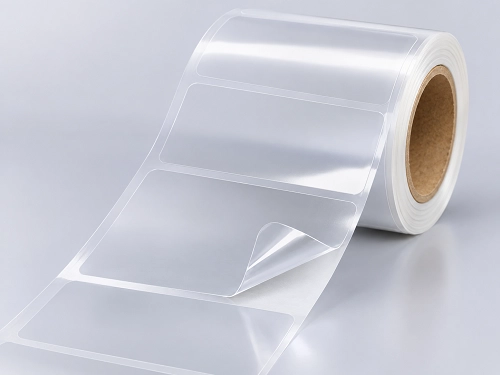
Transparent PP Film Self-Adhesive Labels: How to Get a True "No-Label Look" That Lasts
Clear labels look simple. When one works, the artwork seems to float on the bottle or jar. When one fails, you get silvery air bubbles, a cloudy edge, or a label that lifts at the first squeeze. Buyers who treat transparent polypropylene (PP) film as one interchangeable commodity usually find this out only after a production run.
Why transparent PP film is a popular facestock
Transparent PP film has become a standard choice for premium packaging for four reasons:
- It gives a clean look. Only the printed design is visible, so the container itself becomes part of the branding. This matters most in cosmetics, personal care and beverages.
- It resists moisture and many chemicals. Unlike paper, PP film does not swell or delaminate in damp conditions or when it touches household cleaners.
- It is flexible. At 50 microns, the film conforms to squeezable bottles and gently curved surfaces better than thicker films or paper.
- It is dimensionally stable and printable. It suits flexographic, digital and screen printing when the surface is prepared correctly.
What "50#" means, and what to confirm in writing
In our range, "50#" refers to a 50-micron transparent PP facestock. Thickness is only one part of how a clear label behaves. When you request a quote, also ask for the technical data sheet and confirm:
- Adhesive type and clarity. The adhesive layer is visible through the film, so its colour and aging behaviour matter as much as the film's.
- Liner type. This affects die-cutting, matrix stripping and dispensing speed.
- Surface treatment. Treatment of the printable side decides whether inks and varnishes anchor properly.
- Roll format. Width, length and core size should match your press or applicator.
Product snapshot: 50# Transparent PP Film Self-Adhesive Label
| Parameter | Specification | Why it matters in practice |
|---|---|---|
| Facestock | Transparent PP film, 50 micron | Balances clarity, strength and conformability |
| Adhesive | Hot melt or water-based | Drives initial tack, water behaviour and long-term clarity |
| Liner | Glassine or CCK | Affects die-cutting and automatic dispensing |
| Format | Roll | Suits converting and automatic labelling lines |
| Printing | Flexographic, digital, screen | Covers short runs through high-volume production |
| Resistance | Water, chemicals, UV | Supports indoor and many outdoor uses |
Source: TGX Group product page. Custom specifications are available on request.
Hot melt or water-based adhesive: the choice that decides clarity
On a clear label, the adhesive is part of the visible design. The comparison below is a general starting point. Actual behaviour varies by formulation, so confirm with samples on your own container.
| Consideration | Hot melt adhesive | Water-based adhesive |
|---|---|---|
| Typical strength | Strong initial grab, useful on fast lines | Builds adhesion over time; check dwell requirements |
| Clear-on-clear appearance | Verify colour and aging on your container | Often chosen where maximum clarity is the priority |
| Wet or humid exposure | Test in your actual conditions | Test for whitening after water immersion |
| Best starting point | General packaging and speed-critical applications | Premium clear-on-clear cosmetics and beverage packaging |
Five failure points, and how to avoid them
1. Trapped air. On a clear label every bubble is visible. Apply from the centre outward with even pressure. On automatic lines, check wipe-down or brush settings, because a worn brush leaves tiny channels.
2. Poor ink anchorage. PP is a low-surface-energy plastic, so inks need a properly treated surface. A basic tape test can reveal weak anchorage early. FINAT FTM 21 is the industry's basic ink adhesion test.
3. Missing white underprint. Colour printed directly on clear film takes on the colour of whatever is behind it. A white layer behind the artwork keeps brand colours consistent from one product to the next.
4. Edge lifting on curved or squeezable containers. Thin, flexible film helps here, but only if the adhesive is matched to the container material. Test on the actual container, not a flat test plate.
5. Skipping dwell time. Adhesion keeps building after application. Do not judge a label by what it does in the first minutes. Standard peel testing measures adhesion after 20 minutes and again after 24 hours.
How to test before you buy
The FINAT Technical Handbook is a widely used reference for label stock test methods. It currently features 31 test methods. The ones most relevant to transparent PP labels are:
- FTM 1 and FTM 2: peel adhesion at 180° and 90°, both at 300 mm per minute.
- FTM 9: loop tack, which indicates initial stickiness.
- FTM 13: low temperature adhesion, relevant to chilled products.
- FTM 16 and FTM 17: chemical resistance by spot and immersion.
- FTM 21: basic ink adhesion.
Method numbers are listed in a FINAT presentation from Labelexpo Europe. Check the current handbook edition for exact procedures.
Lab numbers are not enough on their own. We suggest a simple pilot on your real container with your real filling conditions:
- Apply labels to containers on your actual line, or by hand using the same pressure method.
- Wait 24 hours before judging adhesion.
- Expose samples to your real conditions: refrigeration, water or condensation, product contact, and handling.
- Inspect under bright light for bubbles, edge lift, haze and print scuffing.
Food, beverage and pharmaceutical use: check compliance for your market
If labels sit on food packaging, regulations govern the adhesive. In the United States, 21 CFR Part 175 covers adhesives and components of coatings. Section 175.105 sets the conditions for adhesives used in packaging, transporting or holding food. Other regions, including the EU, have their own rules. Compliance depends on the exact adhesive, the application and the market, so request supporting documentation for your use case instead of assuming a general approval.
Where transparent PP labels fit best
- Cosmetics and personal care: bottles, jars and tubes where a sleek, clear label supports the brand.
- Food and beverage: transparent bottles and containers where product visibility is part of the appeal.
- Pharmaceuticals: products needing clear, durable labelling that withstands handling.
- Household and industrial products: cleaners and chemicals where moisture and chemical resistance matter.
See more on our Industries page.
Choosing between our PP film options
Transparent is not always the right answer. If the container is dark or opaque, a white film may give better contrast. For metallic effects, consider silver. Our label material range includes the 50# Silver PP Film and 60# White PP Film labels. For other plastics, see our film label material category, which covers PE, PET and PP films. Adhesive options are described on our adhesive page.
For wider background, these guides from our industry news section may help: BOPP Label Material: The Complete Technical Guide and Self Adhesive Labels: The Complete Technical Guide.
Frequently asked questions
Is a thicker film always better?
No. Thicker film adds stiffness, which can cause lifting on tight curves and squeezable containers. A 50-micron film is a common balance between handling strength and conformability.
Can I use the same adhesive for every container?
Not reliably. Glass, PET, HDPE and other plastics differ in surface energy and flexibility, so test on the actual container.
Will the label look completely invisible?
It can come very close on a clean, well-applied container. Any air, dust or fingerprint trapped under the label will show, so application quality is part of the result.
Can I get samples before ordering?
Yes. Tell us the container material, filling conditions and printing method, and we can recommend a construction to evaluate.