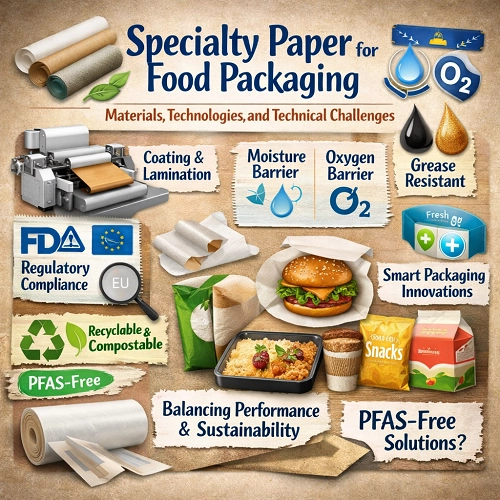
Specialty Paper for Food Packaging: Materials, Technologies, and Technical Challenges
Specialty paper for food packaging represents a rapidly evolving segment of the packaging industry, driven by increasing demand for sustainability, food safety, and performance optimization. Unlike conventional paper, specialty packaging paper is engineered with functional coatings, barrier properties, and structural enhancements tailored to specific food applications. From grease-resistant wraps to high-barrier laminates, these materials must meet stringent regulatory, environmental, and mechanical requirements.
1. Material Composition and Functional Design
1.1 Base Paper Characteristics
The foundation of specialty packaging paper lies in its fiber composition and structure. Key considerations include:
- Fiber type: Hardwood fibers provide smoothness, while softwood fibers contribute strength.
- Grammage (GSM): Determines thickness and durability.
- Porosity: Influences barrier performance and printability.
- Surface finish: Affects coating adhesion and aesthetics.
1.2 Functional Coatings
To meet food packaging requirements, base paper is often modified with coatings such as:
- Polyethylene (PE): Provides moisture resistance and heat-sealability.
- Wax coatings: Used for greaseproof applications like bakery wraps.
- Fluorochemical-free grease barriers: Increasingly adopted due to environmental concerns.
- Water-based dispersions: Offer recyclable and compostable alternatives.
Emerging technologies include bio-based coatings derived from starch, chitosan, or polylactic acid (PLA).
2. Barrier Properties and Performance Metrics
Food packaging must protect contents from environmental factors. Specialty papers are engineered to provide:
2.1 Moisture Barrier
Measured via Water Vapor Transmission Rate (WVTR), this determines how well the paper prevents moisture ingress or loss.
2.2 Oxygen Barrier
Critical for preserving freshness, especially in snacks and processed foods. Oxygen Transmission Rate (OTR) is a key metric.
2.3 Grease Resistance
Important for fast food and oily products. Resistance is often tested using the KIT test or grease penetration methods.
2.4 Aroma and Flavor Retention
Advanced barrier papers prevent flavor migration and external odor contamination.
3. Manufacturing Technologies
3.1 Coating and Lamination
- Extrusion coating: Applies thermoplastic layers for barrier properties.
- Curtain coating: Enables uniform application of water-based coatings.
- Lamination: Combines paper with films (e.g., aluminum foil, bioplastics) for multi-layer performance.
3.2 Surface Treatment
- Corona treatment: Enhances surface energy for better ink adhesion.
- Calendering: Improves smoothness and gloss.
3.3 Converting Processes
Includes cutting, folding, printing, and sealing. Specialty papers must maintain integrity during high-speed converting operations.
4. Food Safety and Regulatory Compliance
Specialty packaging paper must comply with global food safety standards:
- Migration limits: Ensuring no harmful substances transfer to food.
- FDA and EU regulations: Governing materials in contact with food.
- PFAS restrictions: Increasingly important due to environmental and health concerns.
Testing includes:
- Overall migration testing
- Specific migration analysis
- Toxicological assessments
5. Sustainability Considerations
5.1 Recyclability
Traditional coated papers pose recycling challenges. Innovations focus on:
- Repulpable coatings
- Water-dispersible barriers
- Mono-material solutions
5.2 Compostability
Papers with bio-based coatings can meet industrial composting standards (e.g., EN 13432).
5.3 Carbon Footprint
Lifecycle analysis (LCA) is used to evaluate environmental impact, including:
- Raw material sourcing
- Energy consumption
- End-of-life disposal
6. Printing and Branding Requirements
Specialty packaging paper must support high-quality printing for branding and consumer engagement:
- Flexographic printing: Common for high-speed production
- Gravure printing: Offers high detail and consistency
- Digital printing: Enables customization and short runs
Ink compatibility and drying behavior are critical technical considerations.
7. Application-Specific Solutions
7.1 Quick-Service Restaurants (QSR)
- Greaseproof wraps
- Heat-resistant papers
- Anti-stick coatings
7.2 Frozen Food Packaging
- Moisture-resistant barriers
- Low-temperature durability
7.3 Dry Food Packaging
- Oxygen barriers
- Aroma retention
7.4 Liquid Packaging
- Multi-layer structures with high liquid resistance
- Often combined with aluminum or polymer layers
8. Technical Challenges and Future Trends
8.1 Balancing Performance and Sustainability
Achieving high barrier performance without compromising recyclability remains a major challenge.
8.2 PFAS-Free Alternatives
Developing effective grease barriers without fluorochemicals is a key industry focus.
8.3 Scalability of Bio-Based Materials
While promising, bio-based coatings face cost and scalability limitations.
8.4 Smart Packaging Integration
Emerging innovations include:
- Active packaging (antimicrobial layers)
- Intelligent packaging (freshness indicators)
Specialty paper for food packaging is at the intersection of material science, environmental responsibility, and industrial engineering. As regulatory pressures and consumer expectations evolve, the industry must innovate to deliver high-performance, safe, and sustainable solutions. Advances in coating technologies, fiber engineering, and circular design principles will shape the future of this critical packaging segment.