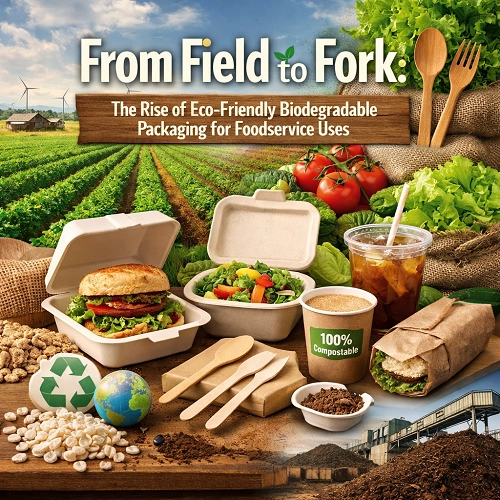
From Field to Fork: The Rise of Eco-Friendly Biodegradable Packaging for Foodservice Uses
As the global foodservice industry confronts mounting pressure to reduce single-use plastic waste, a new generation of compostable, plant-derived packaging materials is rapidly moving from niche to mainstream — redefining what it means to deliver food safely, sustainably, and profitably.
Why Biodegradable Packaging Is Now a Business Imperative
The foodservice sector generates enormous volumes of disposable packaging every day. Takeout containers, burger wrappers, soup cups, and cutlery have traditionally relied on petroleum-based plastics or polyethylene-coated paperboard — materials that persist in landfills for hundreds of years. Legislative shifts across the European Union, North America, and Asia-Pacific are accelerating a transition away from these materials, while consumer surveys consistently show that diners prefer brands that demonstrate genuine environmental accountability.
Eco-friendly biodegradable packaging for foodservice uses, offered by manufacturers such as TGX Group (Targanix), addresses this challenge through material science innovation rather than mere greenwashing. The goal is packaging that performs as reliably as conventional plastic — resisting grease, heat, and moisture — while completing its end-of-life cycle through certified industrial composting.
Core Materials: A Technical Overview
Not all "eco-friendly" packaging is created equal. Material choice determines compostability rate, heat resistance, structural strength, and printability. The leading substrates used in certified biodegradable foodservice packaging are outlined below.
Bagasse (Sugarcane Fibre)
Bagasse is the fibrous residue remaining after sugarcane juice extraction. Once an agricultural waste product destined for incineration, it is now processed into rigid moulded-pulp trays, clamshells, and bowls. Its density of 0.6–0.8 g/cm³ provides robustness comparable to polystyrene foam, while its natural fibre matrix makes it fully compostable. Bagasse products can withstand temperatures up to 120°C — making them suitable for microwave reheating and oven-warming applications.
PLA (Polylactic Acid)
PLA is a bioplastic derived from fermented plant starches — most commonly corn, cassava, or sugarcane. Its optical clarity rivals conventional PET plastic, making it an ideal choice for cold-drink cups, salad boxes, and packaging where product visibility is commercially important. However, PLA has a functional upper temperature limit of approximately 45°C, meaning it should not be used for hot beverages or reheating without hybrid formulations that raise heat deflection thresholds.
Bamboo Pulp
Bamboo is among the fastest-regenerating plants on Earth, capable of reaching harvest maturity in three to five years without replanting. Bamboo-pulp packaging offers higher tensile strength than bagasse and a finer, more uniform surface that supports high-resolution printing. Its biodegradation window of 90–180 days under industrial composting conditions is competitive with other fibre-based substrates.
Greaseproof & Baking Papers
For applications including burger wraps, bakery liners, and deli sheets, speciality papers play a critical role. TGX Group's greaseproof paper and baking paper are engineered without fluorochemical (PFAS) coatings, using mechanical super-calendering or silicone-free barrier treatments to achieve oil resistance levels of 3–5 on the Kit Test scale. These products are compostable when unbleached and chlorine-free variants are chosen.
FSC-Certified Paperboard
Where rigid board is required — sandwich boxes, pizza bases, or meal-prep trays — TGX Group's sustainability commitment includes sourcing FSC® (Forest Stewardship Council®) certified paperboard, ensuring fibres originate from responsibly managed forests with verified chain of custody. PE-free water-based coatings are available to retain full compostability.
| Material | Raw Source | Max Heat Tolerance | Compost Time | Clarity | Best For |
|---|---|---|---|---|---|
| Bagasse | Sugarcane fibre | 120°C (248°F) | 60–90 days | Opaque | Clamshells, bowls, plates |
| PLA | Corn / cassava starch | ~45°C (113°F) | 90–180 days | Clear | Cold cups, salad boxes |
| Bamboo Pulp | Bamboo plant | 110°C (230°F) | 90–180 days | Opaque | Plates, trays, cutlery |
| Wheat Straw | Wheat crop residue | 100°C (212°F) | 60–90 days | Opaque | Plates, containers |
| FSC Paperboard | Certified forest fibre | Varies by coating | 30–90 days | Opaque | Boxes, sandwich packs |
| Greaseproof Paper | Wood pulp (super-calendered) | 220°C (428°F) | 30–60 days | Semi-translucent | Wraps, liners, baking |
Performance Specifications That Matter to Operators
Sustainability credentials alone will not drive foodservice adoption. Operators need to be confident that biodegradable packaging will perform reliably across their specific service environment. The following parameters are key evaluation criteria.
Leak & Grease Resistance
Liquid containment is non-negotiable for soups, curries, and sauce-heavy dishes. Leading bagasse and bamboo clamshells achieve 100% leakproof certification for liquid-based foods. Grease resistance, measured on the TAPPI T 559 (Kit Test) scale of 1–12, should reach level 3–5 minimum for fried-food service and level 6+ for extended greasy-food contact.
Temperature Range
A packaging solution may need to travel from freezer storage (-20°C / -4°F) through ambient distribution to microwave reheating. Bagasse and bamboo-pulp products typically cover this full range. PLA containers, by contrast, are restricted to cold-chain and room-temperature applications unless enhanced with CPLA (crystallised PLA) formulations that raise the heat deflection point to approximately 85°C.
Structural Integrity & Stackability
In high-throughput catering environments, packaging must resist compression during stacking and transport without deforming. Moulded-fibre density directly influences this: a higher-density bagasse board resists flexing better under load. Standardised footprints and nesting geometries improve storage efficiency and reduce distribution costs — an increasingly important factor as delivery logistics costs rise.
Certifications and Regulatory Compliance
Certification is the primary mechanism by which biodegradable claims are independently verified. Foodservice buyers should insist on documented certification from their packaging suppliers rather than relying on self-declared marketing language.
| Certification | Issuing Body | Region Focus | Standard | Compostability Type |
|---|---|---|---|---|
| OK Compost Industrial | TÜV Austria / Vinçotte | Global | EN 13432 | Industrial |
| BPI Certified Compostable | Biodegradable Products Institute | North America | ASTM D6400 | Industrial |
| DIN CERTCO | DIN CERTCO GmbH | Europe | EN 13432 | Industrial |
| OK Compost Home | TÜV Austria | Global | Modified EN 13432 | Home |
| FSC® | Forest Stewardship Council | Global | FSC-STD-01-001 | N/A (chain of custody) |
| FDA Food Contact | U.S. Food & Drug Administration | USA | 21 CFR | N/A (food safety) |
| EU Food Contact | European Commission | EU | Regulation (EC) 1935/2004 | N/A (food safety) |
TGX Group produces packaging compliant with both FDA and EU food-contact regulations. All materials are confirmed BPA-free and produced without chlorine bleaching agents. The company's quality control infrastructure supports batch traceability and third-party laboratory testing to maintain certification currency.
Product Range for Foodservice Operations
Biodegradable foodservice packaging is not a single product but an entire ecosystem of formats engineered for different service occasions. TGX Group's food packaging portfolio covers the full spectrum:
| Product Category | Common Sizes / Variants | Material Options | Key Performance Note |
|---|---|---|---|
| Clamshell Containers | 1-, 2-, 3-compartment | Bagasse, bamboo | Leakproof; microwave-safe |
| Bowls & Lids | 8 oz – 48 oz | Bagasse, paperboard | Stackable; hot & cold |
| Plates & Trays | 7–12 inches | Bagasse, bamboo, wheat straw | Rigid; oven-safe up to 120°C |
| Cold Cups | 8 oz – 32 oz | PLA, paperboard + PLA lining | Clarity comparable to PET |
| Hot Cups & Soup Containers | 8 oz – 32 oz | Bagasse, paperboard | Double-walled options available |
| Cutlery Sets | Fork, knife, spoon, spork | CPLA, bamboo, wheat straw | Individually wrapped options |
| Greaseproof & Baking Paper | Custom roll or sheet sizes | Super-calendered wood pulp | PFAS-free; up to 220°C |
| Sandwich & Burger Wraps | Standard & custom sizes | Foil composite / greaseproof | Heat-retaining; leak-safe |
| Ice Cream Cone Wraps | Various cone diameters | Aluminium foil composite | Moisture barrier; printable |
| Paper Portion Cups | 0.5 oz – 5.5 oz | Paperboard | Condiment & sauce service |
Industries Served and Applicable Use Cases
The versatility of biodegradable foodservice packaging means it spans every segment of the out-of-home eating occasion. From quick-service restaurants and food-truck operators to airline catering and corporate dining, the transition away from single-use plastics is underway across the entire industry. Sectors that benefit most include:
- Restaurants & Fast-Casual Chains — replacing polystyrene and plastic takeout containers at scale.
- Cafés, Bakeries & Beverage Shops — compostable cups, lids, and baked-goods packaging.
- Corporate & School Cafeterias — high-volume tray and cutlery replacement programmes.
- Food Trucks & Mobile Vendors — lightweight, stackable formats optimised for compact storage.
- Airline & Railway Catering — heat-sealed trays compliant with aviation food-safety standards.
- Meal-Prep & Subscription Meal Brands — freezer-to-microwave formats that support the full cold-chain journey.
- Event & Festival Catering — large-volume compostable disposables reducing post-event landfill burden.
TGX Group's Sustainability Framework
Packaging credentials are only as credible as the manufacturing process behind them. TGX Group (Targanix), headquartered in Jiaxing City, Zhejiang Province, China, integrates environmental responsibility throughout its operations through several parallel commitments:
The company sources FSC®-certified paper inputs, ensuring raw-material traceability back to sustainably managed forests. Its manufacturing sites invest in energy-efficient production technologies and renewable energy sources to reduce Scope 1 and Scope 2 greenhouse gas emissions. Internal recycling protocols align with a circular-economy model, targeting zero-landfill production waste. Full details are available on the TGX Group sustainability page.
Beyond environmental metrics, the company maintains transparent sustainability reporting and works with independent certification bodies to verify its claims — a practice increasingly required by institutional procurement teams and international retail buyers.
Customisation, Branding & Commercial Considerations
One of the more underappreciated advantages of modern biodegradable packaging is its printability. Water-based inks on unbleached bagasse or bamboo surfaces deliver brand visibility that matches the consumer's growing preference for authentic, natural aesthetics. Custom shapes, compartment configurations, embossing, and bespoke sizing are all available through TGX Group's service programme, allowing foodservice brands to differentiate their packaging while maintaining sustainability commitments.
From a commercial standpoint, the cost delta between biodegradable and conventional plastic packaging has narrowed considerably as production volumes have scaled. For operators switching at meaningful volume, bulk pricing structures and dedicated account support are available. Buyers can explore the full product range and initiate enquiries through the TGX Group contact page.